I have started this blog to help those in need of security related problems and troubleshooting. I will also talk about new products and concerns in the security industry. please check out my website http://hdview360.com/shop/ for more information
Originally published By Manolo Morales
Published:
Updated:
Security cameras have become an extra set of eyes for homeowners and
businesses to help fight crime, but are they really that effective?
These days, you can find all types of cameras installed in and outside people’s homes, and the images are clearer than ever.
KHON2 wanted to know if they’re actually helping police officers solve crimes.
HPD says cameras have become an important tool for officers, but like
all tools, owners must use them properly and with some discretion.
Chantal Keliihoomalu and her family woke up Tuesday morning and found
out two of their cars, parked right outside their Kapolei home, had
been broken into.
“We noticed that the contents of the middle compartment and the glove
box in our car was emptied out and my husband’s wallet, which had been
in the middle compartment, wasn’t there,” she said.
Her neighbor’s cars were also broken into and a security camera caught the suspect rummaging through the vehicles.
HPD says using security camera footage has become a critical part of an investigation.
“People are sending in a lot more than just, ‘Oh, I saw this guy or I
saw this girl,’ and giving us a description,” said Sgt. Kim Buffett of
Crimestoppers. “They’re like, ‘This is the picture. This is what they’re
doing. This is where I saw it.’ So it really has been helpful to us
solving crimes, definitely.”
Social media has also become part of the arsenal to fight crime. The
Facebook page “Stolen Stuff Hawaii” allows group members to post videos
of crimes in their neighborhood.
In the year and a half since it started, it has grown to 38,000 members and it keeps growing.
“We do see success stories quite frequently,” said Stolen Stuff
Hawaii creator Michael Kitchens. “We see people that have posted, ‘Hey,
we found the guys. Thanks for spreading the word. Somebody reported him.
They saw him. We found our car.’ It is pretty successful in that
regard.”
HPD says there’s no doubt that security cameras have played an
important role in solving all types of cases, but like a lot of things,
it does have its drawbacks.
The biggest one is privacy. Those cameras are only allowed to shoot in areas that are considered public space.
“If you’re going to video someone, make sure it’s in a public place
and nobody has a reasonable expectation of privacy, because then you’ll
be violating their privacy,” said Buffet.
Another common problem HPD faces is owners not being able to download the video when officers arrive.
Buffet asks that you should at least have the manual on hand so officers can figure out how to download the video.
About us:
HD View 360 currently offers a superior line of high-quality HD
Security related products including Cameras, Recorders, IT equipment and
more. The Company has researched the most popular cameras and supplies
and provides those to its end users by way of manufacturing these
products and by direct sales and service. HD View 360 communicates with
consumers and retailers about its products in a variety of ways.
Information about HD View 360—the company as well as its products—is
available via the Internet, direct mailings, and in person. The firms’
promotional efforts and charity support also seek to differentiate its
products from those of its competitors.
The company maintains a personal contact with clients and referrals,
to establish a relationship about the products and services with their
customers. This contact, whether in-person or by phone, helps convey the
HD View 360 message, demonstrate the products’ unique qualities, and
builds solid relationships.
For more information or to schedule an appointment please visit www.hdview360.com
How the 'Internet of Things' will change physical security
originally published by Per Björkdahl On Nov 30, 2015
The integrity of the security we provide as an industry should not be
compromised for IoT. Businesses, governments and people rely on us to
protect what is important and we must continue to maintain the high
standards that currently exist in our industry today. That is not to say
that the physical security industry should ignore IoT, but rather
should be thoughtful and deliberate in its approach to IoT, as we
develop new products, software and systems.
A search for the Internet of Things generates millions of hits on
Google on any given day. To put that into perspective, searches for
Barack Obama and the World Cup generate much fewer hits. The Internet of
Things (IoT) is an idea that many people from across the world are
talking about.
There is healthy debate on what constitutes an Internet of Things.
Discussions about IoT often center on what IoT might mean to future
technologies, product development and sales, without really defining it.
Others argue that an Internet of things already exists, made up by the
integrations of mobile, network and web-based applications, with Web 3.0
promising to deliver an even more personalized user experience. Some
technologists believe that the term IoT only refers to the connection of
objects to other objects, and have coined the term ‘Internet of
Everything’ instead, which consists of the ‘smart networks’ needed to
connect all of these objects.
There are also serious security concerns about the information
exchanged when connecting all of these things together and creating new
access points that leave the safety of a well-secured and finite
network. Early IoT devices are already facing criticism for their
vulnerabilities and their potential for poor security practices, covert
data collection, loss of control of devices and invasions of privacy.
Several well-respected figures, including Stephen Hawking, Bill Gates
and Elon Musk, have expressed concern over the blending of IoT with
artificial intelligence. They say there are real dangers in having
machines make decisions and control objects.
The physical security
community’s discussion of IoT is somewhat different from those of other
industries. Our business is securing things, people and information and
we seek to make assets safe using a combination of physical barriers
and technological tools. Our approach to IoT, therefore, naturally
requires more caution and nuance than most. Those of us in the industry
know that information is not only power, but that it can also be
detrimental to physical security when it falls into the wrong hands.
The physical security industry must exercise caution in developing
products for IoT and capabilities. More data sharing inevitably means
that a security breach on one device or system could result in vast
amounts of data from many systems and devices being compromised. In
fact, HP
recently reported that up to 70 percent of commonly used IoT devices
are vulnerable to cyber attacks. Another point for the industry to
consider is the likelihood of new laws being developed to protect the
end user’s privacy, specifications to which the industry must adhere.
The integrity of the security we provide as an industry should not be
compromised for IoT. Businesses, governments and people rely on us to
protect what is important and we must continue to maintain the high
standards that currently exist in our industry today. That is not to say
that the physical security industry should ignore IoT, but rather
should be thoughtful and deliberate in its approach to IoT, as we
develop new products, software and systems.
It is of particular interest that many within our industry and in the
technology industry at large contend that standards are and will be the
lynchpin to hold together and make IoT a reality. It is predicted that
there will be a global IoT standard in place as early as 2016. The
world’s largest technology-based professional association, IEEE (the
Institute of Electrical and Electronics Engineers), is already at work
developing IoT standards for several technology-based industries.
Several alliances have also formed to work on automation and
communication protocols to prepare for an increase in
(machine-to-machine) communications and the broader IoT. These
alliances, such as Zigbee, the THREADGroup, ZWave and HomeKit, include
physical security manufacturers and organizations in their memberships.
Some alliances have already developed certification specifications, some
of which include video surveillance, intrusion and access control.
Standards
will be fundamental to the development of IoT technology in the
physical security industry, as many have predicted. ONVIF’s
interoperability standards were originally created to take usability to a
higher level by allowing end users to pick and choose technology from
different brands without sacrificing functionality between these
devices. Similarly, IoT will require manufacturers and developers to
work together in establishing baseline standards and specifications that
will further allow physical security systems to not only work with
other physical security devices, but also with other kinds of devices
beyond the confines of our industry.
Though many questions remain, it is clear that the Internet of Things
is already developing and growing in the broader technology market, as
customers purchase more and more connected products and are predicted to
buy even more in the coming year. Verizon, in its 2015 State of the Market IoT report,
predicts that 10 years from now, organizations that use IoT heavily
will likely be up to 10 percent more profitable, with data showing 204
percent growth in the number of IoT connections in the manufacturing
sector. The Internet of Things cannot be ignored, despite its mix of
potential boons and possible weaknesses. It has moved from a conceptual
state to a budding reality, with some calling IoT the next phase of the
industrial revolution. IoT will become a reality in the physical
security industry, of this we can be assured, whether the industry is
prepared or not.
Given the inevitability of the Internet of Things in the physical
security market, the question to be asked is not if IoT will affect our
market, but how best to prepare for and approach IoT. The challenge, of
course, will be to provide increased operability and ease of use for end
users without losing the integrity of the security that we offer as an
industry. We must determine how to best continue our job of protecting
valuable assets while providing end users with the functionality, ease
of use and interoperability they expect, balancing IoT’s strengths with
its weaknesses in our development of products and standards.
HD View 360 is a Surveillance and Security company based in Miami, FL.
HD View 360 specializes in high end residential installations and
commercial Franchise store installations and monitoring.
SILVER SPRING, Md. (Dec. 2, 2015)–The
Security Industry Association (SIA) took part in a roundtable discussion
held at the Indiana Law Enforcement Academy on Nov. 20 by Congressman
Todd Rokita, R, Ind., Chairman of the U.S. House Subcommittee on Early
Childhood, Elementary and Secondary Education.
The purpose of the event was to discuss “how schools can utilize
cutting-edge safety technology to facilitate a productive and safe
learning environment.”
A cross-section of school security solution developers from the
industry participated in the event, led by SIA members Allegion, ASSA
ABLOY, Stanley Security and Tyco Integrated Security. SIA was
accompanied by partner organizations the Partner Alliance for Safer
Schools and the Secure Schools Alliance, through which SIA works
alongside law enforcement and education officials to encourage effective
use of school security technology. The roughly 70 participants also
included Indiana state representatives, safety professionals, law
enforcement officers and school board members.
“We learned that the security industry, law enforcement, and school
officials need to communicate better with each other to understand the
effective technologies available, best practices to utilize, and the
unique challenges present in a learning environment that may include a
public building. Working together is how we prevent tragedies,” Rep.
Rokita said.
“We commend Chairman Rokita for his leadership in hosting such a
timely and relevant discussion, and we were very pleased that the
security industry was included. The discussion shed light on urgent
unmet needs for basic facility security in legacy school structures, as
well as many positive things our communities are doing to address it
that can be an example for others,” SIA Government Relations Director
Jake Parker said.
According to Rep. Rokita’s office, a summary of
the roundtable, including content from breakout sessions as well as
participant feedback, soon will be made available to schools so they can
take advantage of the discussion.
SIA continues to encourage the adoption of best practices,
strengthening partnerships among the security industry, education and
law enforcement communities, reviving federal grant assistance for
school security technology and the adoption of effective state
initiatives to make learning environments safer for our children.
HD View 360 is a Surveillance and Security company based in Miami, FL. HD View 360 specializes in high end residential installations and commercial Franchise store installations and monitoring.
For more information on HD view 360 products and services visit: www.hdview360.com
We have recently Launched our new website at www.HDView360.com
Our Services Include:
Remote Control Systems
Who
says you can’t be everywhere at once? If you have a laptop, smart phone
or any web-enabled device, you’ve got everything you need to check on
your business wherever you are over a highly secure internet connection.
Access and operate your system remotely from anywhere in the world.
You can even download a convenient App! HD View 360’s remote keypad is
the perfect fit for your business because it’s security that goes with
you—so you can enjoy your life and keep an eye on your business at the
same time.
Portable Convenience
Arm and check the status of your security system
Receive and view security-related events
Disarm and silence your system
Multiple account capability—great for vacation homes, investment properties or franchises
Bypass a door for unscheduled maintenance or service
Control garage or warehouse doors
Turn lights on and off remotely
Theft / Asset Protection
Protecting
“portable” electronic devices such as laptop computers, monitors and
peripherals is a universal challenge to business owners. HD View 360’s
asset protection modules can track movement of these devices and sound
an alarm when they are moved outside of a predesignated area. Instantly
receive alerts when expensive equipment is moved or tampered with.
Access Control Systems
Managing access into and throughout your facility
Whatever size your building may be, our systems can monitor what goes
on in and around your facility so you can focus on more important
things – your business.
Restrict Access
Knowledge
of everyone that enters and leaves your facility is critical. HD View
360 offers innovative access control for large or small, multi-site or
single-site locations. Our access control solutions can integrate with
your security system to streamline your operations.
Manage Security 24/7
Our state-of-the-art systems use proximity readers. Forget expensive
key cards and access codes that constantly need updating. Your door
opens when a person approaches and our system logs the person, time and
date. We can also limit access to certain people at pre-defined times of
the day. Let’s design a plan around your business needs.
Environmental Control
Control Your World
Adjust lighting and temperature remotely using easy web-enabled devices.
Monitor your environment
Detect
a failing freezer or furnace, a flooding basement, low heating oil,
burner lockouts and a host of other environmental conditions BEFORE they
become bigger problems.
Detect dangerous carbon monoxide levels or changes in temperature instantly. Our 24/7 monitoring assures that you are alerted immediately if these environmental conditions pose a risk to your business.
Robbery – Hold Up Alarms
Any
business that handles money has the potential to be robbed. An armed
robber is the most dangerous and confrontational criminals.
Increase the longevity of your employees.
Giving your employees the opportunity to summon help undetected ensures their safety and your peace-of-mind.
Let them feel protected at work
From cash drawer alarms to wireless pendants, we make workplace safety a priority.
Video Surveillance
The best security for your business will deter burglars, protect your
employees AND protect you from a multitude of risks that can hurt your
business.
For Peace of Mind
Security Cameras Surveillance for maximum viewing flexibility.
Camera Options:
Closed Circuit television cameras
Indoor domed cameras
Multi-directional outdoor cameras
Infrared, low-light and night vision cameras
Digital Recorders
See your business more clearly.
Video surveillance packages for:
Shrinkage: Helps deter shoplifting and employee theft.
Legal Protection: Reduce your liability from fraudulent claims.
Employee Morale: Helps monitor and improve productivity.
Savings: Lower insurance premiums.
View live-streaming video to monitor action at your workplace or
access your DVR to view historical activity. We’ll customize a package
that’s right for you.
Fire Detection
Commercial fire detection is not just about smoke or heat detectors.
Avoid water and fire damage
At HD View 360, your state-of-the-art sprinkler system is professionally monitored.
We’ll be happy to review your existing plan or design a fire detection program that fits your business and budget.
Jim Sullivan, a manager at
Bread Winners Cafe in Dallas, monitoring restaurant activity from the
back office, via a live video feed.Credit
Dylan Hollingsworth for The New York Times
A digital Big Brother is coming to work, for better or worse.
Advanced
technological tools are beginning to make it possible to measure and
monitor employees as never before, with the promise of fundamentally
changing how we work — along with raising concerns about privacy and the
specter of unchecked surveillance in the workplace.
Through
these new means, companies have found, for example, that workers are
more productive if they have more social interaction. So a bank’s call
center introduced a shared 15-minute coffee break, and a pharmaceutical
company replaced coffee makers used by a few marketing workers with a
larger cafe area. The result? Increased sales and less turnover.
Yet
the prospect of fine-grained, digital monitoring of workers’ behavior
worries privacy advocates. Companies, they say, have few legal
obligations other than informing employees. “Whether this kind of
monitoring is effective or not, it’s a concern,” said Lee Tien, a senior
staff lawyer at the Electronic Frontier Foundation in San Francisco.
When
Jim Sullivan began working as a waiter at a Dallas restaurant a few
years ago, he was being watched — not by the prying eyes of a human
boss, but by intelligent software.
The
digital sentinel, he was told, tracked every waiter, every ticket, and
every dish and drink, looking for patterns that might suggest employee
theft. But that torrent of detailed information, parsed another way,
cast a computer-generated spotlight on the most productive workers.
Mr.
Sullivan’s data shone brightly. And when his employer opened a fourth
restaurant in the Dallas area in 2012, Mr. Sullivan was named the
manager — a winner in the increasingly quantified world of work.
Still,
even people involved in the workplace analytics business say rules
governing privacy are needed, if the emerging industry is to flourish.
Ben
Waber is chief executive of Sociometric Solutions, a start-up that grew
out of his doctoral research at M.I.T.’s Human Dynamics Laboratory,
which conducts research in the new technologies. Sociometric Solutions
advises companies using sensor-rich ID badges worn by employees. These
sociometric badges, equipped with two microphones, a location sensor and an
accelerometer, monitor the communications behavior of individuals —
tone of voice, posture and body language, as well as who spoke to whom
for how long.
Sociometric
Solutions is already working with 20 companies in the banking,
technology, pharmaceutical and health care industries, involving
thousands of employees. The workers must opt in to have their data
collected. Mr. Waber’s company signs a contract with each one
guaranteeing that no individual data is given to the employer (only
aggregate statistics) and that no conversations are recorded.
“Privacy policy,” Mr. Waber said, “is going to have to deal with the workplace and not just the consumer issues.”
The
payoff for well-designed workplace monitoring, Mr. Waber said, can be
significant. The underlying theme of human dynamics research is that
people are social learners, so arranging work to increase productive
face-to-face communication yields measurable benefits.
For
example, the company studied workers in Bank of America call centers
and observed that those in tightknit communications groups were more
productive and less likely to quit. To increase social communication,
the shared 15-minute coffee break was introduced to the daily routine.
Afterward, call-handling productivity increased more than 10 percent, and turnover declined nearly 70 percent, Mr. Waber said.
Mr.
Waber’s company also provided the data-guided insight to help the
pharmaceutical company increase sales with its new cafe area. At a tech
company, his company found, workers who sat at larger tables in the
cafeteria, thus communicating more, were more productive than workers
who sat at smaller tables.
Bryan
Koop, a commercial office developer who has worked with Sociometric
Solutions, points to the potential for more scientifically designed work
environments. There are current fashions in office design, he said,
that are assumed to increase productivity, like stationing workers at
communal bench-style tables and constructing work cubicles with lower
dividers.
“We
don’t know if those tactics work,” Mr. Koop said. “What we’re starting
to see is the ability to quantitatively measure things instead of just
going by intuition.”
Skeptics
warn of a digital-age rerun of Frederick Winslow Taylor’s “scientific
management” from a century ago, whose excesses were satirized in Charlie
Chaplin’s “Modern Times.”
Taylor’s instrument of measurement was the stopwatch, used to time and
monitor a worker’s every movement. His time-and-motion studies
determined the best way to do work.
Initially,
Taylorism was hailed as a progressive force that would free workers
from the whim of autocratic bosses and benefit all. “This is the way
workplace analytics is being presented now,” said Peter Cappelli,
director of the Center for Human Resources at the Wharton School of the
University of Pennsylvania.
But the ideas of Taylorism, he said, were simplified and hardened into a speedup dogma used by bosses, and workers hated it.
Digital
tools for workplace surveillance, according to Lamar Pierce, an
associate professor at Olin Business School at Washington University in
St. Louis, can be simplistically viewed as either good or bad. “The real
challenge for all of us,” he said, “is what is the right level and in
what context is it being done.”
Mr. Pierce was a co-author of a research paper
published last year that examined the effect of the monitoring software
used in restaurants, like the one in Dallas where Mr. Sullivan works,
on employee behavior.
The
researchers studied the data on all transactions and patterns
suggesting theft, before and after the software was installed, at 392
restaurants, in 39 states. The savings from the theft alerts themselves
were modest, at $108 a week per restaurant. More startling, revenue
increased an average of $2,982 a week at each restaurant, about 7
percent, a sizable gain in the low-margin restaurant industry.
Servers,
knowing they were being monitored, pushed customers to have that
dessert or a second beer, which resulted in the increased revenue for
the restaurant and tips for themselves.
The
monitoring software is a product from NCR called Restaurant Guard. The
product, introduced in 2009, exploits the rapid progress in so-called
big data technology, for collecting, storing and analyzing vast amounts
of data. “That’s the big change that makes this possible,” said Jeff
Hughes, general manager for digital insight at NCR.
]The
software is used in several thousand restaurants. But to test the
prototype software in 2008, Mr. Hughes visited his brother Jim Hughes,
who owns a few Bread Winners Cafes, a midprice restaurant in the Dallas
area. The software has steadily improved, he said, so that it now “lets
you see everything that goes on in a restaurant.”
Today,
Mr. Sullivan is the one using software to monitor workers. For example,
he said, the data might show that someone who is efficient at serving
several tables is not very good at sales, if that person’s average
ticket is less than the restaurant’s.
That
server, Mr. Sullivan said, would benefit from advice on how to talk to
customers and suggest featured dishes and drinks. “The data allows me to
go back and coach and train them,” Mr. Sullivan said, “so we can make
more money and so can they.”
for more information on HD view 360 services and products visit www.hdview360.com
A version of this article appears in print on June 22, 2014, on page A1 of the New York edition with the headline: Unblinking Eyes Track Employees. Order Reprints|Today's Paper|Subscribe
Samsung’s mobile devices are known for integrating some of the best
cameras available, and they will continue to improve with new
technologies. On the other hand, their digital camera business didn’t
take off as much as the company wanted, so much that reports have
indicated that Samsung might stop making
these devices. Still, Samsung acquired SmartThings to start building
technology for smart appliances and compete with systems like Google’s
Nest. A month ago, Samsung announced a SmartThings Kit
dedicated to monitoring homes from a smartphone with several sensors
and interconnected devices including a surveillance camera called
SmartCam HD Pro.
Now, Samsung has announced another camera called SmartCam HD Plus
with a completely new design and some improvements. The camera may be
controlled with a dedicated mobile app available for Android or iOS
devices, which is known to not be as intuitive or streamlined as the
Nest app. It includes a large sensor that records video in Full HD
resolution and up to five viewing streams are available, so multiple
people can watch the content at the same time. The two-way talk lets
users hear what’s happening around the camera and reply through their
smartphone. The camera detects only relevant movement or noise, so users
won’t be alerted by e-mail or push notifications for normal incidents
happening in the background, additionally, users can choose specific
areas to detect movement.
The SmartCam HD Plus supports several lighting conditions as it
features IR Cut Filter for dark scenes, providing clear video up to 32
feet away in total darkness, plus the Light Enhancer produces clear
images from scarce illumination and the Wide Dynamic Range create clear
images of subjects even when there’s a bright light in the background.
It features an ultra-wide lens capable of recording video in 130°, so
more elements can fit into the image. The camera includes a microSD card
slot (up to 128 GB) to store video. The SmartCam HD Plus is smaller
than the Pro version and it now features a black color, so it is more
discrete. It can be purchased in the US at Costco for $139.99, although
there are no details of availability in other regions yet.
For the latest in Surveillance technology and service please visit www.hdview360.com
JACKSON, Miss. (WJTV) – Surveillance cameras are one thing that
should make you feel secure at home or at work. What you might not know
is that some of those cameras are viewable online anytime, by anyone,
day or night. Some cameras are viewable in countries around the world —
from here in the United States to Argentina to Denmark and everywhere in
between. There are more than 8,700 on one website called http://www.insecam.org.
Melissa Wiggins, a computer science professor at Mississippi
College says, “They’re unsecured and people put them in bedrooms and
babies nurseries. And places that they would not want the general public
to be able to see what they’re doing or who was there.”
The Insecam project labels itself as the world’s biggest directory
of online surveillance cameras. It shows everything from inside houses,
street views, parking lots, offices, and beaches. The types of cameras
used vary and include Axis, Panasonic, Linksys, Sony, and TPLink.
Some of the cameras are here in Mississippi. One is on a front
porch in Clinton. With the click of a mouse, you can zoom in and change
the camera angle. WJTV 12 wanted to let the homeowner know that their
camera was viewable online and we tried tracking down the location of
the home, even enlisting the help of the Clinton Police Department. No
one was able to find the exact location, but Wiggins says a more
computer savvy person might be able to find it. According to
Wiggins, “The information varies. On some sites, you get latitude and
longitude. You can get the address on that camera and using tools on the
Internet you can track back to locate that camera. It depends on how
much information The Internet service provider and other groups
provide.”
Wiggins says unprotected cameras open up your home or business for
break-ins. They also open you up to online threats, like having personal
information or banking information stolen from computers connected to
your network. Wiggins says, “If it doesn’t have to be on the Internet
don’t put it on the Internet. Turn the wireless off. If it does need to
be on the Internet you need to secure everything from the point that the
connection comes into your house to the camera. And any other device
that might be on the Internet as well.”
The website http://www.insecam.org
claims that the cameras are not hacked, but none of them are password
protected. The site also states that any private or unethical camera
will be removed immediately if you email the administrator a complaint.
The best way to protect your camera is to either disconnect the WIFI or
change the username and password.
With HD View 360 you never need to worry about a story like this. All of our camera installations are provided by our fully screened technicians with experience in securing your cameras from online intrusions.
For more information on how to protect your home with the right setup and camera combination please visit our website at www.hdview360.com
Automated license plate recognition systems, also known as ALPR or simply LPR systems, have become increasingly popular — and controversial
— tools for law enforcement in recent years. The systems can
automatically photograph and record data on license plates in real time,
drawing the ire of privacy advocates like those at the Electronic
Frontier Foundation, which has just released information on security
vulnerabilities in ALPR systems across the country.
"Earlier this year, EFF learned that more than a hundred ALPR cameras
were exposed online, often with totally open Web pages accessible by
anyone with a browser," the organization says in the new report released today.
The report focuses on systems sold by a company called PIPS
Technology, which is now owned by 3M. According to the EFF, live feeds
from some of the cameras were available to watch online, and "were
individually connected to the internet and freely accessible online to
anyone who knew where to look."
The organization described its testing approach:
The testing process involved confirming that a camera was
online and responding to requests by connecting to it with a Web browser
or by connecting to it over Telnet. If the camera had a password on
both the Web and Telnet interface we left it alone, but if the camera
was not protected with a password we were able to recover configuration
information. However, when the Web was locked down, but Telnet was not,
we [were] able to view password information in the Telnet configuration.
Often these passwords were set to the default or were otherwise not
sophisticated enough to be secure.
Using information embedded on the page and through publicly available
sources, the EFF was able to identify the position of some of the
cameras, and got in touch with the owners to highlight the
vulnerabilities. Some, like local Louisiana law enforcement agencies and
the University of Southern California, took steps to fix the
vulnerabilities. But the city of Hialeah, Florida, stopped returning the
organization's calls.
The ACLU has found
that about three-quarters of law enforcement agencies were using
similar systems in 2011, giving officers "hundreds of millions of data
points" on drivers not accused of a crime.
Dennis Mancino is the CEO of HD View 360 a Miami based Surveillance company focusing on B2B installations and service
This post was originally posted: By Colin Lecher on
HDCVI is the earliest high definition technology, which has been developed from the ground up especially for apply in the CCTV industry. The hdcvi
is a way for megapixel high definition applications, featuring
non-latent and long-distance transmission at a lower price. HDCVI can
send out data more than 500 meters (1640 feet) without the requirement
of any additional equipment. This feature can be very advantageous in
replacing installed analog cameras and DVRs without the need of running
latest cables or installing data repeating strategy.
HDCVI technology
offers 2 specifications such as 1080p that is 1920×1080 resolution and
720p that is 1280×720 resolution. The camera kit includes both hdcvi cameras and hdcvi dvrs. This
technology gives an easy solution to the customers who are looking at
their first security system or already has a security system but wants
to upgrade with high definition without any problem. This hdcvi systems compatibility not only saves money but also saves time and work. It make very easy to upgrade older systems to hd-cvi systems in a smooth and an easy way.
Therefore, one of the best benefits of choosing hd-cvi
technology that place out is its backwards compatibility by older
systems. It has developed to work through the similar coaxial cable that
has expected already been laid out by earlier CCTV setups. The coaxial
cable is not only able to transmit signals but also transmits different
types of signals as well. The hd-cvi cameras and hd-cvi dvrs
can be connected with each other all the way through coaxial cable with
high definition video signals, high definition audio signals and
two-way control signals, which allow you to adjust the PTZ position of
your cameras.
Other than HDCVI camera, IP security cameras and NVRs (Network Video
Recorders) are new series of innovations. These are made for use as
network/Internet distribution devices like web cams, which have been
adapted in the CCTV. But, there are some differences in hdcvi vs ip cameras so you should choose according to your needs.
For the quality of the educational experience as well
as the safety of the students, it’s important that schools view safety
as the highest priority. Administrators need to closely examine the
security options available to them in the video surveillance
marketplace. They should begin with a thorough look at what
network-based video technology can do in the community’s local
educational facilities, compared to traditional analog systems.
Today, the industry is in the middle of a paradigm
shift as it slowly gravitates from analog video systems to digital
Internet protocol (IP). Use of IP-based video is on the rise, and
nowhere else in society is this new flavor of video surveillance as well
received.
According to Peter Boriskin, vice president of product
management for Tyco International’s Access Control and Video Systems,
IP’s current market share is roughly 15 percent.
Erron Spalsbury, account manager with 3xLogic, Westminster, Colo., said his company sees a growing interest in IP. “About 80 percent of every DVR [digital video recorder] we sell records video from at least one IP camera,” Spalsbury said.
Use of network-based video Since the 1950s, security companies have installed and
serviced analog cameras in educational facilities as well as in
commercial, industrial and retail markets. For the most part, analog
technology has served the industry well, but since the introduction of
computer networking in education, the number of IP video installations
has more than doubled each year.
In a growing number of schools, colleges and
universities, IP cameras allow officials to better track and identify
suspicious individuals as they enter and leave facilities. IP cameras
allow administrators to monitor parking lots, sidewalks and critical
entrances with greater clarity and efficiency.
When real-time observation is not feasible, IP video
allows images to be recorded on an assortment of digital media for later
review. Network video offers the advantage of capturing real-time
events as they happen and storing them on a computer hard drive. And
because of megapixel imagers, IP video has the ability to record images
in near-to-life resolution. Because of their digital nature, images from an IP
camera also can be easily exported for law enforcement use without
degrading image quality. A watermark within the digital framework of
each image verifies its authenticity. This is especially important when
video images are removed as evidence to use in a court of law.
Megapixel IP cameras also allow schools to do more
with fewer employees, which is important to cash-strapped institutions.
Through the use of live and recorded video, the number of security
personnel can often be reduced and replaced with IP video cameras.
Instead of a school full of security officers, many educational
facilities can effectively function with a handful.
Digital IP vs. analog cameras
An IP camera is designed to connect to a computer
network or a recording device, such as a DVR, network video recorder,
network attached storage or some other method of image retention. With
an IP camera, this is accomplished using a Category 5e or 6 cable with
eight-position modular plugs. An analog camera, in contrast, uses a
coaxial cable plus a second cable for power.
IP cameras are assigned a unique address for
identification purposes, which is also a feature that separates the
technology from analog. This address enables the network to store images
in separate folders corresponding to the specific cameras. IP addresses
allow networks to associate specific information with each image, such
as camera location, date, time, camera type, etc. This enables system
operators to readily identify where a scene comes from inside or outside
the facility. In some cases, the network superimposes other data
onto an image, such as cash register transaction information. Because
it’s in a digital format, advanced searches can be conducted using any
number of criteria. For a good example, consider the retail side of a
college or university, such as a book store or cafeteria. Data from
credit cards or other identification credentials can be used to locate a
student in real time or through recorded video. Integration with other
subsystems, such as access control, enables school officials to review
an audit trail of student and staff member activities, reviewing images
from nearby cameras in the process.
Another difference between IP and analog cameras is
the format used to send image information over a wire. Conventional
cameras use the National Television Standards Council (NTSC) standard,
commonly referred to as composite video. A conventional video camera
bundles everything needed to create an image within a single composite
signal. This signal contains lumina (brightness/contrast) and chroma
(image color) information as well as synchronization pulses for display
scanning control. The typical bandwidth of a composite video signal is 6
MHz at 1 volt peak-to-peak. This is a lot of information that must be
carried by the analog signal; therefore, a lot can be lost through
electromagnetic interference.
Digital IP-based data is not as prone to outside
interference as analog because it’s easier for the head-end system to
detect the two voltage states of a digital data signal than the nearly
infinite number of frequencies used in an analog signal. This makes
digital IP more robust than analog, especially in locations experiencing
a high-level of radio frequency interference, such as airports and
industrial plants.
It is easier to place intelligence on the edge of the
network using IP cameras than with analog. Software can be added to
provide video analytics, e-mail and more. Some IP cameras have a
built-in Web server, which adds a degree of redundancy to any video
surveillance system. If something happens to the main method of image
recording, relevant images may still exist.
Adding cameras to an existing infrastructure
Another advantage to using IP cameras is the relative
ease with which they can be added to an existing local area network
(LAN). Most educational facilities have a LAN installed throughout the
buildings. This eliminates the need to install coaxial and power cables
from one end of each building to the other, which must be done when
installing analog cameras. Not only does this save time, but it also
saves money because installers do not have to contend with the same
amount of metallic cable.
“In this environment, where cost is a significant
driver, being able to use the existing infrastructure allows us to
reduce the installation cost to the customer,” Spalsbury said. “And not
only is the wire (Category 5e) cheaper when it comes time to install a
network, but it’s easier to pull. And it makes it easier and faster to
expand when needed. In addition, IP technology makes it possible to
record multiple facilities on the enterprise level and to do so using
megapixel-type cameras.”
Not only do IP cameras use Category 5e or 6 cable,
which is generally cheaper than coaxial, but sometimes the choice can be
between installing a $700 megapixel camera with a 6-foot extension cord
to a network’s wall outlet to get a robust, high-resolution picture or
paying an installer $500 to run new coaxial cable the entire distance of
a school for analog. IP video also allows for rapid deployment where
there is an existing network, something educational facilities may need
as security requirements change.
“An environment like that of a school is constantly
changing and so will their need for covert and overt camera placement,”
Boriskin said. “An IP video strategy allows for much easier camera
movement.”
Balancing the need for IP video
Opponents of IP-based video cameras maintain that such
a pie-in-the-sky approach to video surveillance is not worth the cost.
Ask some information technology (IT) managers, and they may say
attaching IP cameras to a school’s network isn’t practical because the
cameras require a lot of bandwidth.
While it is true that not every school requires
megapixel quality video, those that use one say you can’t have too much
resolution when it comes to proving your case in court.
“The most compelling reason to use IP is the simplest
one: don’t send 12 hours of an empty stairwell at 3 MB per second. Use
the camera as a gate-keeper so only interesting video is sent,” Boriskin
said.
In this case, when a camera is first installed, it
will send a complete image of the stairwell. After that, only those
pixels that have changed are sent to the head-end.
Although digital high-resolution cameras may not be
ideal for every application, they are a potent new tool in the security
expert’s bag of tricks.
Dennis Mancino is the CEO of HD View 360 located in Miami FL. for more information visit the website at www.hdview360.com
Video compression is the process of using a codec to go
through your video files to reduce or eliminate unnecessary files. This
makes your video files smaller, so you can store more video on your NVR
hard drive or camera’s MicroSD card.
There are two main types of compression, H.264 and MJPEG,
while MPEG4 is an older version. Almost all IP surveillance camera come
with a video compression codec.
How Video Compression Works
To compress your files, the codec looks for unnecessary files
or frames it can reduce or eliminate without impacting the final
version of the video. This process is done automatically by your
surveillance camera, but you can often choose which style of video
compression to use and the compression level within the video:
H.264 compression – this is the newest, and
most efficient video compression codec, and it works by taking small
groups of frames and evaluating them together as a series to eliminate
duplicate content that appears in each frame without changing
MJPEG compression – also called motion
JPEG, works by evaluating each frame of the video, compressing them,
and sending them as individual JPEG images
MPEG4 compression – this is an older style of video compression, and has largely been replaced by H.264
If you are also recording audio with your surveillance video, the audio files will be compressed separately from the video.
For cameras that have multiple video streams, your camera may
also be able to use multiple video compression codec’s or different
levels of compression. This allows you to configure on stream for mobile
viewing, one stream for live viewing, and one stream for long-term
storage.
A national fitness franchise has security cameras
installed to monitor the 21,000 sq. ft. gym 24-7 for theft, employee
misconduct, & other threats. Read Now
How Video Compression Can Help You
Video compression is a valuable tool when your video
surveillance system has bandwidth and storage limitations, since video
files can be extremely large if they are long clips or recorded in
megapixel resolution. If your video is compressed too much, though, the
image quality can be compromised—our surveillance experts can help you
find the best balance of compression and image quality.
By compressing the video files your system can more easily
send the files over your network without significant delays or slowing
it down, which is especially important for mobile viewing with a smart
phone or tablet.
Compressed video files also take up less space on your hard
drive, allowing you to store more videos or keep the files for longer
periods of time.
Video compression codec’s are available in video surveillance systems and IP security cameras from D View 360.
Video compression is an essential part of recording and saving
security camera footage, because it compresses the raw files into a
smaller format. This allows you to store more videos on your hard drive.
There are three types of video compression:
H.264 compression - This is the best, most efficient way to compress
your video files. It compresses the files by evaluating small groups of
images together and removing duplicates.
MJPEG compression - This format works by evaluating each frame of
the video and compressing it. This is also referred to as motion JPEG,
because it treats each frame as an individual JPEG image.
MPEG4 compression - This is the oldest format, and is not commonly used. It has largely been replaced by H.264 compression.
What makes video compression an important part of your surveillance
is the ability to compress files - this maximizes your hard drive space
so you can store more videos for longer periods of time before your hard
drive is full.
Large video files become a problem when you record extremely long
videos, or high quality HD videos. A 30 second video your camera
automatically records on motion won't be very large, but a 10 minute
video of a break-in at your store will. Additionally, a video recorded
at 5MP and a full 30 FPS will be helpful in identifying suspects in a
video, but also be a very large file.
Who’d have thought it?
If you’ve ever been involved in the technology business, even just as
a casual observer, you’ll know that innovation is often the unintended
consequence of developments in other, seemingly, unrelated, areas.
Google, for example, simply wouldn’t exist if it wasn’t for the Internet
or the need for an efficient search engine to navigate the
ever-burgeoning world-wide web. Similarly, the dragging of CCTV into the
21st century looks set to become the unrelated consequence of the
cloud, a technology, in turn, spawned by our never-ending love affair
with everything mobile.
Domino effects
There’s no getting away from it, the Internet has touched and
transformed virtually every part of our modern lives. However, it’s far
from static or complete – it grows, it develops and changes. As
witnessed in the last few years by the ready availability of mobile
Internet access using smartphones and tablets, enabling us to both work
and play wherever we want, whenever we want.
By itself, however, the ability to stay connected to the web isn’t
enough – we also need to be able to access shared data, connect to our
inboxes and calendars, communicate with colleagues and so on. A need
that is increasingly being met, not by conventional (and let’s face it –
complicated) VPN tunneling to private networks, but through the cloud.
The cloud and the services it hosts are transforming the way we work,
making it much easier to stay in touch as well as connected and do real
work on the move. It also helps keep us and our data secure without the
need for complex security measures which, when applied using
conventional VPN technologies, can discourage the use of the very
resources they are designed to protect.
And so to CCTV
So what’s this all got to do with CCTV? To answer that let’s start
with the acronym – CCTV, or Closed Circuit TV – which, by its very
nature implies limits on what the technology can do.
It’s “closed” so, for example, you can’t get at what’s being captured
remotely, at least not without a lot of highly technical and expensive
add-ons. And that means it just doesn’t fit in a world where we
routinely expect to be able to do almost everything, from turning down
the heating to checking what’s in the fridge, from our mobiles.
“But wait” I hear you cry, “IP technology can fix that, can’t it?”
Well, yes and no. IP cameras by themselves are no more accessible
than their analogue counterparts. They simply digitize the analogue
video streams and transmit them over an IP network, again, requiring
expensive and complicated gateways to provide for remote access.
More than that, IP cameras can unintentionally take the “Closed” out
of CCTV, with serious implications when it comes to security.
Get your network security measures wrong by mis-coding a firewall
rule or forgetting to change the default password and, in theory, anyone
could access not just your IP cameras, but the network video recorders
and monitoring systems to which they connect.
Yes – that’s right – unless you expressly make it your goal to
prevent unauthorized access to an IP surveillance system, anyone could
find it, watch it and, even, interfere with it. Add to that the fact
that you need to be a rocket scientist to install and manage an IP
surveillance system at all and you start to understand why analogue CCTV
still reigns supreme in the security market.
With the advent of the cloud, however, that really does look set to change.
Surveillance from the cloud
The cloud is the final piece of the jigsaw, and it changes
everything. Connect cameras to a hosted surveillance system like
Cloudview for example, and you can take full advantage of what IP
technology has to offer, not least by making it easy to access the
system remotely without the need for complicated security measures.
All you need is a browser and an Internet connection and you can
check up on what’s happening from a smartphone, tablet or laptop. More
than that, with the Cloudview Visual Network Adapter (VNA) you can
connect both analogue and, soon, digital IP cameras to the cloud without
the need for a costly and complicated local network infrastructure. You
don’t even need wires as it can all be done over WiFi or a 3G mobile
network.
And lastly, with security handled professionally as part of the
hosted surveillance service the cloud also puts the “Closed” back into
CCTV, insuring that your data can only be accessed by people authorized
to see it.
You might want to think of it as Cloud Circuit TV but, whatever the
name, it’s set to change the face of surveillance and, finally, bring it
into our mobile 21st Century world.
Below is a lesson in the Do's and Dont's of security camera placement. At HD View 360 you can trust us to make sure you don't violate the law. We pride ourselves on a professional installation each and every time and followup service that is prompt and available at any time.
Store says security cameras above fitting room not recording people changing
By Joe Douglass, On Your Side InvestigatorPublished: Oct 6, 2015 at 5:59 PM PDT
PORTLAND, Ore. – A woman told KATU
she felt violated after spotting enclosed surveillance cameras above a
fitting room at a local clothing store.
A manager of the store said the cameras were not pointed at the fitting room.
Corenna Khieu said she had just tried on a skirt when she looked up and saw the two cameras.
“Immediately, like, my heart just sank,” she said.
Khieu was with her 2-year-old daughter at the time.
"She's a baby,” Khieu said, “and I just thought, you know, who else is able to see this?"
The two were shopping at the Urban Kingdom clothing store on Northeast Martin Luther King Jr. Boulevard Monday afternoon.
"I only looked up just because I have a spider phobia,” said Khieu,
“so I was just wanting to make sure no spider was gonna get on me."
After spotting the cameras she said she tried starting a conversation with a store employee.
"It seemed like the little things that I was saying to him about
something else totally different, it wasn't like it was registering very
well,” she said.
Khieu said she then went home, called the Portland Police Bureau’s non-emergency line, then contacted KATU.
We then shared her story with James Lee, one of the store's managers.
"I apologize if it caused a concern,” said Lee.
He and a store employee showed us surveillance footage from the cameras going back more than a week.
In the footage, the cameras are pointed away from the dressing rooms.
None of it shows people undressing.
Lee said the cameras are locked in with screws and very hard to move around.
When asked if he’d still consider moving the cameras, Lee said, “"I
could if it needs to be … Maybe we could put a plate underneath it. Let
them know there is no way the camera can go down into the dressing room.
Maybe that might be an idea … I want customers to have zero doubt that
camera can view inside the dressing room."
A spokesman for the Portland Police Bureau said they're not investigating the case.
He said, generally, recording someone who has their clothes off without their permission is a crime.
Dennis Mancino is CEO of HD view 360 located in Miami,FL. HD view 360 services small businesses all over the United States and can handle any size job. Whether you need 1 store outfitted or 1000 we can handle the job and it will be done right the first time,
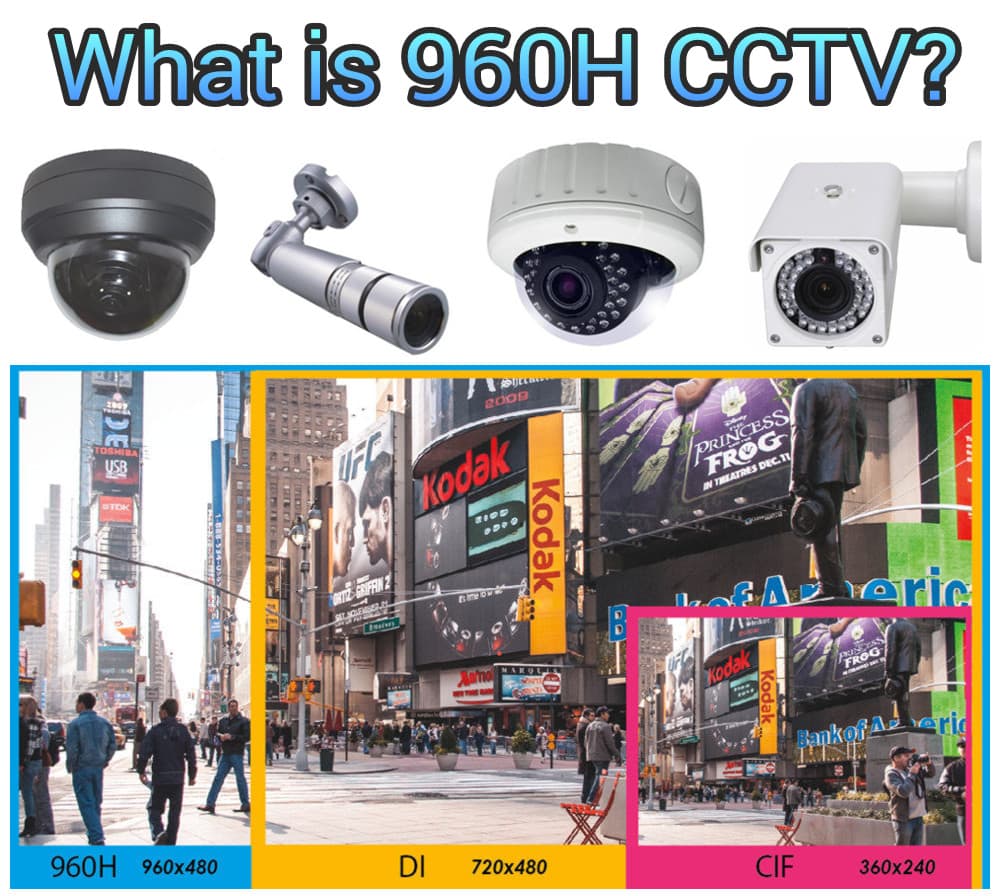
This article explains what 960H video is and answers frequently asked
questions about how 960H resolution is used in modern CCTV cameras and
security DVRs.
What is 960H?
960H is the latest video resolution used by analog CCTV
camera surveillance systems. The “H” in 960H stands for “horizontal” and
960 is the number of horizontal pixels in the video resolution. 960H is
960 x 480 video resolution. Unlike the generation of CCTV cameras and
DVRs before 960H became a standard, 960H uses the 16:9 widescreen aspect
ratio which makes it more suitable for use with modern widescreen
format monitors and HDTVs. Almost all of modern monitors are 16:9 aspect
ratio.
What resolution was used in CCTV before 960H?
Before 960H cameras and DVRs were available, the most popular video
standard for CCTV systems was D1 resolution. D1 resolution is 720 x 480
pixels, sometimes D1 is 704 x 480 pixels. Notice that the width of the
picture is wider when comparing 960H to D1, but the height is the same.
D1 resolution uses a 4:3 aspect ratio which was much more popular 10
years ago, before the advent of widescreen monitors and high def
television. CIF resolution (also shown in the top image on this page) is
360 x 240 (sometime 352 x 240). It is basically half the size of D1 and
also uses the 4:3 aspect ratio. CIF resolution is typically used when
bandwidth or recording hard drive space is limited.
960H vs D1
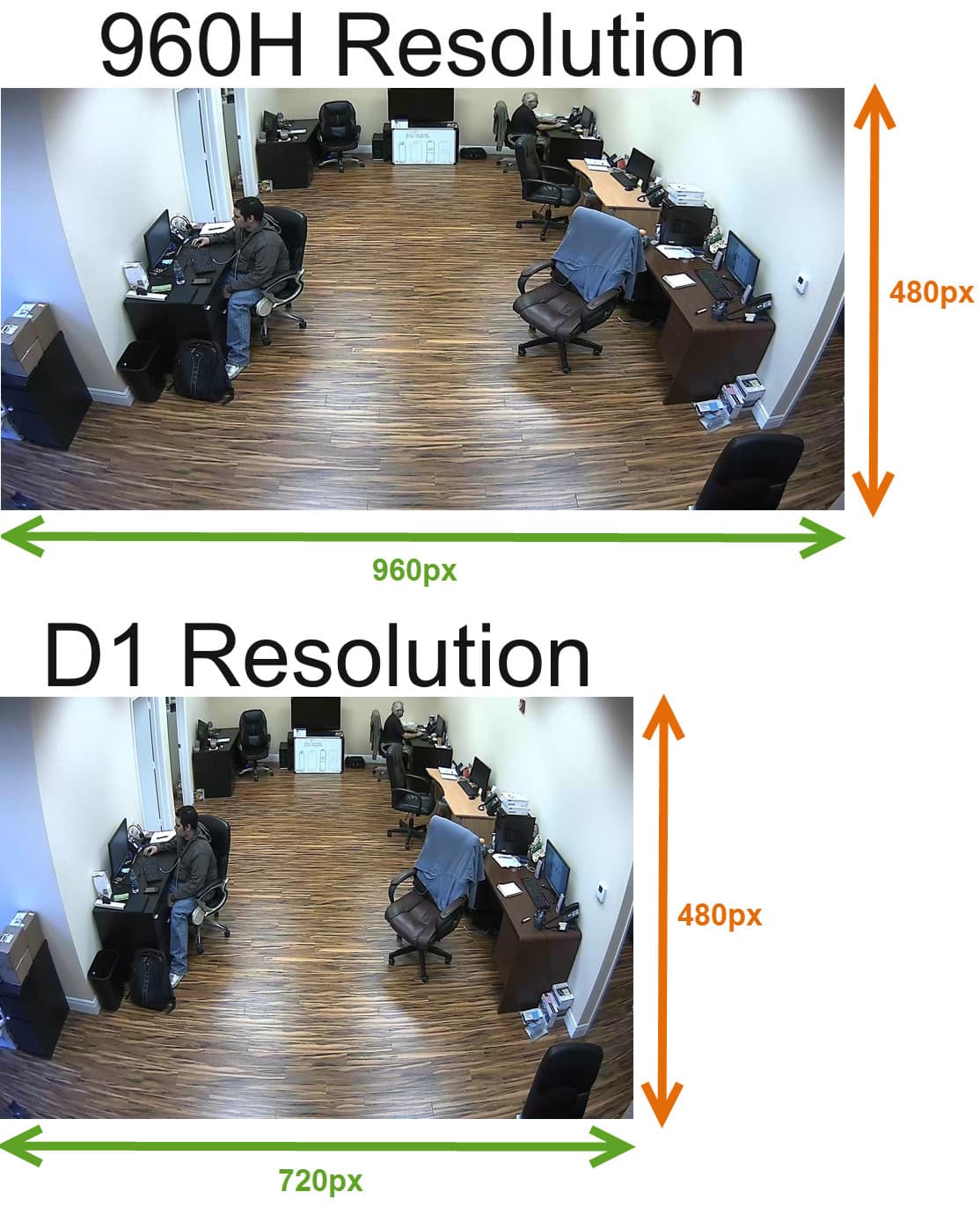
The below images compare 960H vs D1 video resolution. Please click on the image for a full sized view.
Do 960H cameras provide more video coverage than D1 cameras?
No. The angle of view / view-able area covered by a security camera
is determined by the size of the lens and the size of the image sensor
(the electronic chip that actually captures the image). Almost all CCTV
cameras use a 1/3 inch image sensor. This includes 960H and D1 format
cameras. Lens sizes do vary. In the above images, a 3.6mm lens was used.
Notice that although the 960H image is wider than the D1 image, the
angle of view is the same. The wider format image does not mean that a
wider angle of view is captured. It just means that more pixels were
used and the picture is wider.
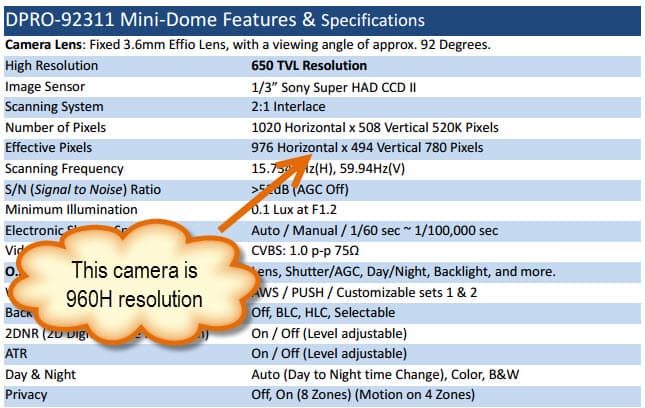
How do I know if a CCTV camera is 960H resolution?
It is easy to confirm if a CCTV camera is 960H resolution by looking
at the technical specification of the camera. Typically, there is a
section in camera spec that documents the effective resolution of the
camera in pixels. If the resolution width is 960 pixels or greater and
the height is 480 pixels or greater, the camera is 960H. Below is a
snapshot taken from the specification of a 960H camera.
Most CCTV cameras that are 960H resolution are 650 TVL or greater.
TVL stands for television lines and is a another way to measure the
resolution of analog cameras. You should not assume that all 650TVL or
700TVL cameras are 960H. In some cases, the image sensor of a 700TVL
camera is not actually capable of capturing 960 x 480 pixels. You should
always go by the effective pixels on the camera’s spec.
How can I use the new 960H format?
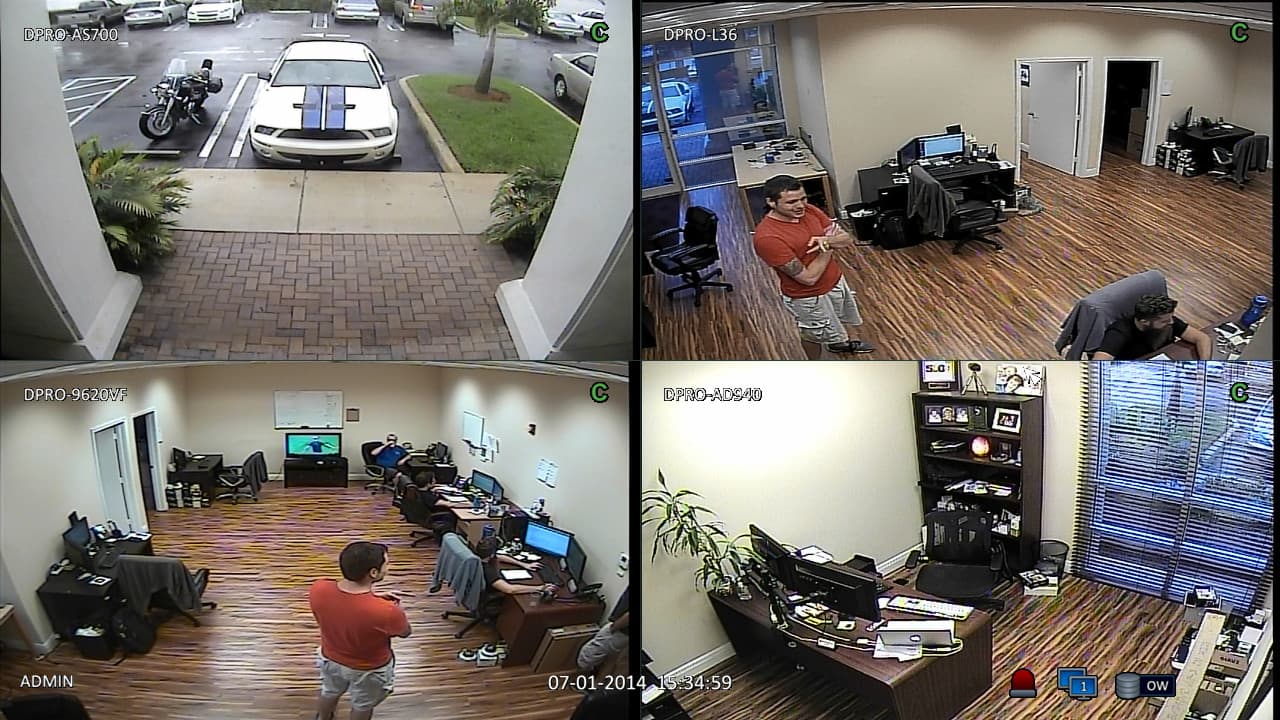
In order to full take advantage of the 960H format in video surveillance applications, you should use both a 960H camera and a 960H DVR.
The above picture is a screenshot taken from an iDVR-PRO4A DVR
(supports 960H video format) connected to 4 960H cameras. This is what
the user sees from a monitor connected directly to the DVR’s VGA or HDMI
video output. The DVR actually supports full 1080p monitor resolution,
but unfortunately the video capture card that we used to grab this image
only supports 720p resolution. Please click on the image for a full size view.
Can I use 960H cameras with a D1 DVR?
Yes. Actually, 960H resolution cameras were available in the market
before 960H DVRs were available. CCTV camera resolutions seem to always
advance before DVR resolutions catch up. When you use a 960H camera with
a D1 resolution DVR, the image is simply compressed by the DVR to fit
the maximum resolution that the DVR supports. No view of the image is
lost. The image as a whole is just shrunken down to fit. It makes sense
for customers shopping for new CCTV cameras to purchase 960H cameras
even if they do not plan on updating their DVR to 960H right now. When
the time comes to replace their DVR, they will already have cameras that
take advantage of the wider format resolution.
Can I use my older non-960H cameras with a 960H DVR?
Yes. This is also a typical scenario. Many customers have existing
CCTV cameras that are not 960H but provide a perfectly good picture that
they are happy with. D1 / 4:3 apect ratio CCTV cameras will work fine
with 960H DVRs. The DVR simply stretches the width of the image to fit
the 960H resolution. This stretch is not drastic and most people do not
even notice. 960H DVRs are backward compatible with non-960H cameras.
Do 960H and D1 cameras use the same cable?
Yes, the same coax cable (typically RG59) is used for both 960H and
D1 CCTV cameras. The same BNC video connectors are also used. The only
differece is the size of the image that they capture. All of the same
wiring can be used.
How does 960H compare to HD CCTV (HD-SDI)?
Although 960H cameras and HD-SDI cameras use the same type of coaxial
cable (RG59 or RG6), they are two very different technologies. HD-SDI
is a digital video signal and can support much higher resolutions than
analog CCTV. HD-SDI cameras require HD-SDI recorders and support full
1080p video resolution.
Request a 960H System Demo
Would you like to login to an 960H surveillance system from iPhone,
iPad, Android, Windows or Mac to experience 960H video surveillance for
yourself? Please click here to request a demo login.
What is AHD CCTV?
Update! Since this article was first written, AHD CCTV has been
introduced. AHD is an HD security camera standard that allows 720p and
1080p video to transmit using the same RG59 coax cable as 960H CCTV
cameras. If you are interested, you can learn more about AHD CCTV here. On that page, we have a video demonstration that compares 960H vs 720p AHD surveillance video
Dennis Mancino Is CEO of HD View 360, a surveillance and IT company form Miami, FL.
For more information please visit www.hdview360.com
source for article: http://videos.cctvcamerapros.com/surveillance-systems/what-is-960h-video.html





 At HD View 360, your state-of-the-art sprinkler system is professionally monitored.